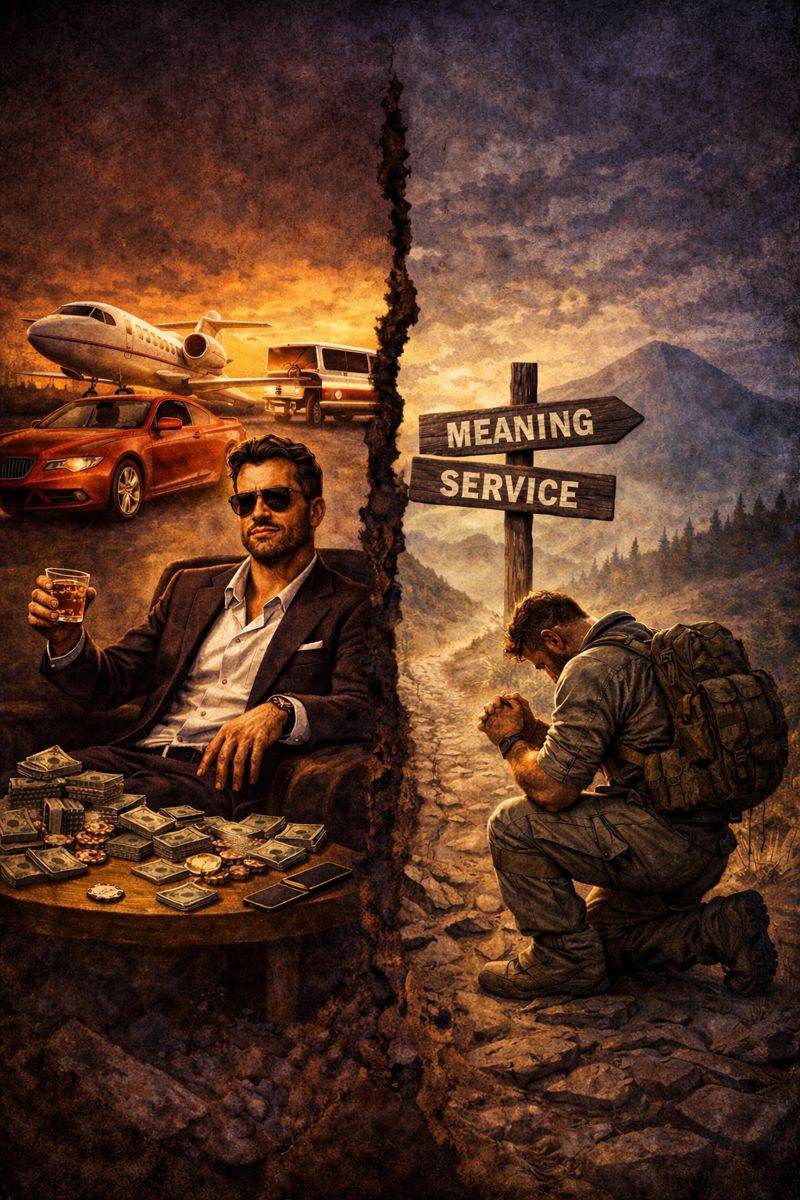
There is a quiet paradox at the heart of modern masculinity.
The more you gain, the more you expect.
The more you expect, the less you become.
Many men arrive at the same crossroads eventually. They accumulate money, status, attention, and experiences that culture promised would deliver fulfillment—yet still feel hollow. Not exhausted, but empty.
Rich in the Bank, Poor in the Soul
Recent public examples make this hard to ignore.
Dan Bilzerian lived what social media framed as the ultimate fantasy: wealth, yachts, exotic travel, endless women, and total freedom from consequence. And yet, by his own admission, he found himself searching for something deeper—something with meaning.
Andrew Tate followed a different path but arrived at a similar conclusion. After achieving immense financial success and notoriety, he publicly acknowledged the need for spiritual grounding, ultimately turning toward faith as an anchor.
Different lives. Different personalities. Same realization.
You can be rich in the bank and poor in the soul.
The Thoreau Principle
Henry David Thoreau captured this truth long before Instagram ever existed:
“The measure of a man’s wealth is what he can afford to live without.”
True wealth is not accumulation—it is orientation. What do you need to feel whole? And more importantly, what can you release without losing yourself?
The Problem With the “High-Value Man” Movement
The modern “high-value man” movement was meant to restore male confidence and standards. In theory, it emphasized self-respect, competence, and achievement.
In practice, much of it has devolved into something hollow.
Instead of producing men who understand their value through responsibility, it has produced a loud subculture of men who measure value through leverage—money, geography, status, and access.
The so-called passport bro phenomenon is a prime example: men who use entire regions of the world as transactional marketplaces for validation, while simultaneously demonstrating the absence of true masculinity.
These are not powerful men.
They are children who can shave.
Loud. Obnoxious. Self-centered. Materialistic. Treating women as objects rather than responsibilities. Their behavior does not increase masculinity—it erodes it.
Masculinity is not proven by what you consume. It is proven by what you carry.
Responsibility Is the Source of Value
True masculine value has always been rooted in responsibility:
- Responsibility over yourself
- Responsibility over your actions
- Responsibility over your family
- Responsibility over your community
- Responsibility over the world immediately in front of you
When men lose this orientation, everything becomes a tool for self-gratification—relationships, experiences, possessions, even people.
Rather than making themselves tools for service, they demand the world serve them.
And the cost is immense.
Families fracture. Communities weaken. Children inherit instability. This is not accidental—it is the predictable outcome of self-centered masculinity.
Why Divorce Is So High Among the Moderately Successful
Many men stumble not in failure, but in comfort.
They earn enough to feel entitled. Enough to say, “I deserve better.” Enough to focus the lens inward instead of outward.
Instead of asking:
- How can I be better?
- How can I serve more fully?
They ask:
- What am I not getting?
- Who isn’t meeting my needs?
When that happens, responsibility is replaced by resentment—and relationships collapse under the weight of unmet selfish expectations.
The King David Pattern
This is not a new story.
Even King David—a warrior, a king, a man after God’s own heart—fell into emptiness when he abandoned responsibility for indulgence. Power without service led him into moral collapse.
Every man who pursues selfish pleasure long enough finds himself at the same crossroads.
Social media likes run out. Status fades. Attention shifts. And meaning, once ignored, comes knocking.
The Higher Call: Embracing Suffering for Others
True masculinity does not avoid suffering—it accepts it willingly for the sake of others.
This is the defining mark of a high-value man.
To place yourself second. To serve first. To carry weight so others don’t have to.
This is not weakness. It is strength properly ordered.
The Paradox: In Service, You Gain the Kingdom
There is a reason this pattern appears across faith, philosophy, and history.
Andrew Carnegie summarized it powerfully:
“You can make more friends in two months by becoming interested in other people than you can in two years by trying to get other people interested in you.”
Highly successful people—those with depth, not just money—orient themselves outward.
They serve.
And paradoxically, in doing so, they gain everything that selfish striving promises but never delivers.
A Daily Practice for Real Men
If you want to embody real value, start small and start daily.
Take the first hour of every day and orient yourself in service.
Write down answers to one simple question:
How can I serve today?
It might look like:
- Making coffee for your wife
- Cutting fruit in the morning for your kids
- Fixing something broken in someone else’s life
- Showing up fully when it’s inconvenient
- Dropping to your knees in prayer or quiet reflection
These acts will never go viral.
But they will build something far greater than status.
Be Truly Valuable
Stop chasing the label of “high-value.”
Become valuable.
Not by what you take from the world—but by what you carry for it.
This is the paradox.
And this is the path.